
(PHP 4, PHP 5)
mysql_error — Возвращает текст ошибки последней операции с MySQL
Описание
mysql_error(resource $link_identifier = NULL): string
Список параметров
-
link_identifier -
Соединение MySQL. Если идентификатор соединения не был указан,
используется последнее соединение, открытое mysql_connect(). Если такое соединение не было найдено,
функция попытается создать таковое, как если бы mysql_connect() была вызвана без параметров.
Если соединение не было найдено и не смогло быть создано, генерируется ошибка уровняE_WARNING.
Возвращаемые значения
Возвращает текст ошибки выполнения последней функции MySQL,
или '' (пустую строку), если операция
выполнена успешно.
Примеры
Пример #1 Пример использования mysql_error()
<?php
$link = mysql_connect("localhost", "mysql_user", "mysql_password");mysql_select_db("nonexistentdb", $link);
echo mysql_errno($link) . ": " . mysql_error($link). "n";mysql_select_db("kossu", $link);
mysql_query("SELECT * FROM nonexistenttable", $link);
echo mysql_errno($link) . ": " . mysql_error($link) . "n";
?>
Результатом выполнения данного примера
будет что-то подобное:
1049: Unknown database 'nonexistentdb'
1146: Table 'kossu.nonexistenttable' doesn't exist
aleczapka _at) gmx dot net 
18 years ago
If you want to display errors like "Access denied...", when mysql_error() returns "" and mysql_errno() returns 0, use $php_errormsg. This Warning will be stored there. You need to have track_errors set to true in your php.ini.
Note. There is a bug in either documentation about error_reporting() or in mysql_error() function cause manual for mysql_error(), says: "Errors coming back from the MySQL database backend no longer issue warnings." Which is not true.
Florian Sidler 
13 years ago
Be aware that if you are using multiple MySQL connections you MUST support the link identifier to the mysql_error() function. Otherwise your error message will be blank.
Just spent a good 30 minutes trying to figure out why i didn't see my SQL errors.
Pendragon Castle 
14 years ago
Using a manipulation of josh ><>'s function, I created the following. It's purpose is to use the DB to store errors. It handles both original query, as well as the error log. Included Larry Ullman's escape_data() as well since I use it in q().
<?php
function escape_data($data){
global $dbc;
if(ini_get('magic_quotes_gpc')){
$data=stripslashes($data);
}
return mysql_real_escape_string(trim($data),$dbc);
}
function
q($page,$query){
// $page
$result = mysql_query($query);
if (mysql_errno()) {
$error = "MySQL error ".mysql_errno().": ".mysql_error()."n<br>When executing:<br>n$queryn<br>";
$log = mysql_query("INSERT INTO db_errors (error_page,error_text) VALUES ('$page','".escape_data($error)."')");
}
}
// Run the query using q()
$query = "INSERT INTO names (first, last) VALUES ('myfirst', 'mylast'");
$result = q("Sample Page Title",$query);
?>
l dot poot at twing dot nl 
16 years ago
When creating large applications it's quite handy to create a custom function for handling queries. Just include this function in every script. And use db_query(in this example) instead of mysql_query.
This example prompts an error in debugmode (variable $b_debugmode ). An e-mail with the error will be sent to the site operator otherwise.
The script writes a log file in directory ( in this case /log ) as well.
The system is vulnerable when database/query information is prompted to visitors. So be sure to hide this information for visitors anytime.
Regars,
Lennart Poot
http://www.twing.nl
<?php
$b_debugmode = 1; // 0 || 1$system_operator_mail = 'developer@company.com';
$system_from_mail = 'info@mywebsite.com';
function
db_query( $query ){
global $b_debugmode;// Perform Query
$result = mysql_query($query);// Check result
// This shows the actual query sent to MySQL, and the error. Useful for debugging.
if (!$result) {
if($b_debugmode){
$message = '<b>Invalid query:</b><br>' . mysql_error() . '<br><br>';
$message .= '<b>Whole query:</b><br>' . $query . '<br><br>';
die($message);
}raise_error('db_query_error: ' . $message);
}
return $result;
}
function
raise_error( $message ){
global $system_operator_mail, $system_from_mail;$serror=
"Env: " . $_SERVER['SERVER_NAME'] . "rn" .
"timestamp: " . Date('m/d/Y H:i:s') . "rn" .
"script: " . $_SERVER['PHP_SELF'] . "rn" .
"error: " . $message ."rnrn";// open a log file and write error
$fhandle = fopen( '/logs/errors'.date('Ymd').'.txt', 'a' );
if($fhandle){
fwrite( $fhandle, $serror );
fclose(( $fhandle ));
}// e-mail error to system operator
if(!$b_debugmode)
mail($system_operator_mail, 'error: '.$message, $serror, 'From: ' . $system_from_mail );
}?>
Anonymous 
18 years ago
My suggested implementation of mysql_error():
$result = mysql_query($query) or die("<b>A fatal MySQL error occured</b>.n<br />Query: " . $query . "<br />nError: (" . mysql_errno() . ") " . mysql_error());
This will print out something like...
A fatal MySQL error occured.
Query: SELECT * FROM table
Error: (err_no) Bla bla bla, you did everything wrong
It's very useful to see your query in order to detect problems with syntax. Most often, the output message from MySQL doesn't let you see enough of the query in the error message to let you see where your query went bad- it a missing quote, comma, or ( or ) could have occured well before the error was detected. I do -not- recomend using this procedure, however, for queries which execute on your site that are not user-specific as it has the potential to leak sensative data. Recomended use is just for debugging/building a script, and for general user-specific queries which would at the worst, leak the users own information to themself.
Good luck,
-Scott
olaf at amen-online dot de 
18 years ago
When dealing with user input, make sure that you use
<?php
echo htmlspecialchars (mysql_error ());
?>
instead of
<?php
echo mysql_error ();
?>

Otherwise it might be possible to crack into your system by submitting data that causes the SQL query to fail and that also contains javascript commands.
Would it make sense to change the examples in the documentation for mysql_query () and for mysql_error () accordingly?
Anonymous 
22 years ago
some error can't handle. Example:
ERROR 1044: Access denied for user: 'ituser@mail.ramon.intranet' to database 'itcom'
This error ocurrs when a intent of a sql insert of no authorized user. The results: mysql_errno = 0 and the mysql_error = "" .
Gianluigi_Zanettini-MegaLab.it 
16 years ago
"Errors coming back from the MySQL database backend no longer issue warnings." Please note, you have an error/bug here. In fact, MySQL 5.1 with PHP 5.2:
Warning: mysql_connect() [function.mysql-connect]: Unknown MySQL server host 'locallllllhost' (11001)
That's a warning, which is not trapped by mysql_error()!
scott at rocketpack dot net 
19 years ago
My suggested implementation of mysql_error():
$result = mysql_query($query) or die("<b>A fatal MySQL error occured</b>.n<br />Query: " . $query . "<br />nError: (" . mysql_errno() . ") " . mysql_error());
This will print out something like...
<b>A fatal MySQL error occured</b>.
Query: SELECT * FROM table
Error: (err_no) Bla bla bla, you did everything wrong
It's very useful to see your query in order to detect problems with syntax. Most often, the output message from MySQL doesn't let you see enough of the query in the error message to let you see where your query went bad- it a missing quote, comma, or ( or ) could have occured well before the error was detected. I do -not- recomend using this procedure, however, for queries which execute on your site that are not user-specific as it has the potential to leak sensative data. Recomended use is just for debugging/building a script, and for general user-specific queries which would at the worst, leak the users own information to themself.
Good luck,
-Scott
josh ><> 
19 years ago
Oops, the code in my previous post only works for queries that don't return data (INSERT, UPDATE, DELETE, etc.), this updated function should work for all types of queries (using $result = myquery($query);):
function myquery ($query) {
$result = mysql_query($query);
if (mysql_errno())
echo "MySQL error ".mysql_errno().": ".mysql_error()."n<br>When executing:<br>n$queryn<br>";
return $result;
}
phpnet at robzazueta dot com 
16 years ago
This is a big one - As of MySQL 4.1 and above, apparently, the way passwords are hashed has changed. PHP 4.x is not compatible with this change, though PHP 5.0 is. I'm still using the 4.x series for various compatibility reasons, so when I set up MySQL 5.0.x on IIS 6.0 running PHP 4.4.4 I was surpised to get this error from mysql_error():
MYSQL: Client does not support authentication protocol requested by server; consider upgrading MySQL client
According to the MySQL site (http://dev.mysql.com/doc/refman/5.0/en/old-client.html) the best fix for this is to use the OLD_PASSWORD() function for your mysql DB user. You can reset it by issuing to MySQL:
Set PASSWORD for 'user'@'host' = OLD_PASSWORD('password');
This saved my hide.
miko_il AT yahoo DOT com 
19 years ago
Gianluigi_Zanettini-MegaLab.it 
16 years ago
A friend of mine proposed a great solution.
<?php
$old_track = ini_set('track_errors', '1');
.....
if (
$this->db_handle!=FALSE && $db_selection_status!=FALSE)
{
$this->connected=1;
ini_set('track_errors', $old_track);
}
else
{
$this->connected=-1;
$mysql_warning=$php_errormsg;
ini_set('track_errors', $old_track);
throw new mysql_cns_exception(1, $mysql_warning . " " . mysql_error());
}
?>
Gerrit 
8 years ago
The following code returns two times the same error, even though I would have expected only one:
$ conn = mysql_connect ('localhost', 'root', '');
$ conn2 = mysql_connect ('localhost', 'root', '');
mysql_select_db ('db1', $ conn);
mysql_select_db ('db2', $ conn2);
$ result = mysql_query ("select 1 from dual", $ conn);
$ result2 = mysql_query ("select 1 from luad", $ conn2);
echo mysql_error ($ conn) "<hr>".
echo mysql_error ($ conn2) "<hr>".
The reason for this is that mysql_connect not working as expected a further connection returns. Since the parameters are equal, a further reference to the previous link is returned. So also changes the second mysql_select_db the selected DB of $conn to 'db2'.
If you change the connection parameters of the second connection to 127.0.0.1, a new connection is returned. In addition to the parameters new_link the mysql_connect() function to be forced.
mysqli_error
(PHP 5, PHP 7, PHP 
mysqli::$error — mysqli_error — Возвращает строку с описанием последней ошибки
Описание
Объектно-ориентированный стиль
Процедурный стиль
mysqli_error(mysqli $mysql): string
Возвращаемые значения
Строка с описанием ошибки. Пустая строка, если ошибки нет.
Примеры
Пример #1 Пример с $mysqli->error
Объектно-ориентированный стиль
<?php
$mysqli = new mysqli("localhost", "my_user", "my_password", "world");/* Проверить соединение */
if ($mysqli->connect_errno) {
    printf("Соединение не удалось: %sn", $mysqli->connect_error);
    exit();
}
if (!
$mysqli->query("SET a=1")) {
printf("Сообщение ошибки: %sn", $mysqli->error);
}/* Закрыть соединение */
$mysqli->close();
?>
Процедурный стиль
<?php
$link = mysqli_connect("localhost", "my_user", "my_password", "world");/* Проверить соединение */
if (mysqli_connect_errno()) {
    printf("Соединение не удалось: %sn", mysqli_connect_error());
    exit();
}
if (!
mysqli_query($link, "SET a=1")) {
printf("Сообщение ошибки: %sn", mysqli_error($link));
}/* Закрыть соединение */
mysqli_close($link);
?>
Результат выполнения данных примеров:
Сообщение ошибки: Unknown system variable 'a'
Смотрите также
- mysqli_connect_errno() — Возвращает код ошибки последней попытки соединения
- mysqli_connect_error() — Возвращает описание последней ошибки подключения
- mysqli_errno() — Возвращает код ошибки последнего вызова функции
- mysqli_sqlstate() — Возвращает код состояния SQLSTATE последней MySQL операции
information at saunderswebsolutions dot com 
17 years ago
The mysqli_sql_exception class is not available to PHP 5.05
I used this code to catch errors
<?php
$query = "SELECT XXname FROM customer_table ";
$res = $mysqli->query($query);
if (!
$res) {
printf("Errormessage: %sn", $mysqli->error);
}?>
The problem with this is that valid values for $res are: a mysqli_result object , true or false
This doesn't tell us that there has been an error with the sql used.
If you pass an update statement, false is a valid result if the update fails.
So, a better way is:
<?php
$query = "SELECT XXname FROM customer_table ";
$res = $mysqli->query($query);
if (!
$mysqli->error) {
printf("Errormessage: %sn", $mysqli->error);
}?>
This would output something like:
Unexpected PHP error [mysqli::query() [<a href='function.query'>function.query</a>]: (42S22/1054): Unknown column 'XXname' in 'field list'] severity [E_WARNING] in [G:database.php] line [249]
Very frustrating as I wanted to also catch the sql error and print out the stack trace.
A better way is:
<?php
mysqli_report(MYSQLI_REPORT_OFF); //Turn off irritating default messages$mysqli = new mysqli("localhost", "my_user", "my_password", "world");$query = "SELECT XXname FROM customer_table ";
$res = $mysqli->query($query);
if (
$mysqli->error) {
try {
throw new Exception("MySQL error $mysqli->error <br> Query:<br> $query", $msqli->errno);
} catch(Exception $e ) {
echo "Error No: ".$e->getCode(). " - ". $e->getMessage() . "<br >";
echo nl2br($e->getTraceAsString());
}
}//Do stuff with the result
?>
Prints out something like:
Error No: 1054
Unknown column 'XXname' in 'field list'
Query:
SELECT XXname FROM customer_table
#0 G:\database.php(251): database->dbError('Unknown column ...', 1054, 'getQuery()', 'SELECT XXname F...')
#1 G:dataWorkSites1framework5testsdbtest.php(29): database->getString('SELECT XXname F...')
#2 c:PHPincludessimpletestrunner.php(58): testOfDB->testGetVal()
#3 c:PHPincludessimpletestrunner.php(96): SimpleInvoker->invoke('testGetVal')
#4 c:PHPincludessimpletestrunner.php(125): SimpleInvokerDecorator->invoke('testGetVal')
#5 c:PHPincludessimpletestrunner.php(183): SimpleErrorTrappingInvoker->invoke('testGetVal')
#6 c:PHPincludessimpletestsimple_test.php(90): SimpleRunner->run()
#7 c:PHPincludessimpletestsimple_test.php(498): SimpleTestCase->run(Object(HtmlReporter))
#8 c:PHPincludessimpletestsimple_test.php(500): GroupTest->run(Object(HtmlReporter))
#9 G:all_tests.php(16): GroupTest->run(Object(HtmlReporter))
This will actually print out the error, a stack trace and the offending sql statement. Much more helpful when the sql statement is generated somewhere else in the code.
se (at) brainbits (dot) net 
17 years ago
The decription "mysqli_error -- Returns a string description of the LAST error" is not exactly that what you get from mysqli_error. You get the error description from the last mysqli-function, not from the last mysql-error.
If you have the following situation
if (!$mysqli->query("SET a=1")) {
$mysqli->query("ROLLBACK;")
printf("Errormessage: %sn", $mysqli->error);
}
you don't get an error-message, if the ROLLBACK-Query didn't failed, too. In order to get the right error-message you have to write:
if (!$mysqli->query("SET a=1")) {
printf("Errormessage: %sn", $mysqli->error);
$mysqli->query("ROLLBACK;")
}
callforeach at gmail dot com 
8 years ago
I had to set mysqli_report(MYSQLI_REPORT_ALL) at the begin of my script to be able to catch mysqli errors within the catch block of my php code.
Initially, I used the below code to throw and subsequent catch mysqli exceptions
<?php
try {
$mysqli = new mysqli('localhost','root','pwd','db');
if ($mysqli->connect_errno)
throw new Exception($mysqli->connect_error);
} catch (
Exception $e) {
echo $e->getMessage();
}I realized the exception was being thrown before the actual throw statement and hence the catch block was not being called.My current code looks like
mysqli_report(MYSQLI_REPORT_ALL) ;
try {
$mysqli = new mysqli('localhost','root','pwd','db');
/* I don't need to throw the exception, it's being thrown automatically */} catch (Exception $e) {
echo $e->getMessage();
}This works fine and I'm able to trap all mysqli errors
abderrahmanekaddour dot aissat at gmail dot com 
9 months ago
<?php// The idea is the add formated errors information for developers to easier bugs detection.$myfile = fopen("database_log.log", "r");
$db = new mysqli("localhost", "root","root","data");
if(!$db->query("SELECT")){
  $timestamp = new DateTime();
  $data_err = " {
     "title": " Select statement error ",
     "date_time": ".$timestamp->getTimestamp().",
     "error":" ".$db->error." "
     } "; // Do more information
  fwrite($myfile, $data_err); // writing data
}
    // In separate file do file read and format it for good visual.$db->close();
fclose($myfile);
?>
asmith16 at littlesvr dot ca 
9 years ago
Please note that the string returned may contain data initially provided by the user, possibly making your code vulnerable to XSS.
So even if you escape everything in your SQL query using mysqli_real_escape_string(), make sure that if you plan to display the string returned by mysqli_error() you run that string through htmlspecialchars().
As far as I can tell the two escape functions don't escape the same characters, which is why you need both (the first for SQL and the second for HTML/JS).
information at saunderswebsolutions dot com 
17 years ago
Hi, you can also use the new mysqli_sql_exception to catch sql errors.
Example:
<?php
//set up $mysqli_instance here..
$Select = "SELECT xyz FROM mytable ";
try {
    $res = $mysqli_instance->query($Select);
}catch (mysqli_sql_exception $e) {
    print "Error Code <br>".$e->getCode();
    print "Error Message <br>".$e->getMessage();
    print "Strack Trace <br>".nl2br($e->getTraceAsString());
}?>
Will print out something like
Error Code: 0
Error Message
No index used in query/prepared statement select sess_value from frame_sessions where sess_name = '5b85upjqkitjsostvs6g9rkul1'
Strack Trace:
#0 G:classfileslib5database.php(214): mysqli->query('select sess_val...')
#1 G:classfileslib5Session.php(52): database->getString('select sess_val...')
#2 [internal function]: sess_read('5b85upjqkitjsos...')
#3 G:classfilesincludes.php(50): session_start()
#4 G:testsall_tests.php(4): include('G:dataWorkSit...')
#5 {main}
Anonymous 
3 years ago
mysqli_report(MYSQLI_REPORT_ERROR | MYSQLI_REPORT_STRICT);
try {
                $this->connection = mysqli_connect($hostname,$username,$password, $dbname);
} catch (Exception $e) {
                echo "Errno: " . mysqli_connect_errno() . PHP_EOL;
                echo "Text error: " . mysqli_connect_error() . PHP_EOL;
                exit;
}
i am unable to get the last 2 echos to work, even if the update query fails it still displays success. If anyone has any suggestions on this code to be improved on any line, please do!
<?php
        if(!empty($_POST['username']) && !empty($_POST['answer']))  {
            $username = $_POST['username'];
            $idfetch = mysql_query("SELECT id FROM users WHERE username ='$username'") //check it
            or die(mysql_error());
            $fetched = mysql_fetch_array($idfetch);
            $id = $fetched['id']; //get users id for checking
            $answer = $_POST['answer'];
            $password = (mysql_real_escape_string($_POST['password']));
            $confpass = (mysql_real_escape_string($_POST['confpass']));
            if ($password != $confpass) {
                echo ("Passwords do not match, please try again.");
                exit;
            }
            $updatequery = mysql_query("UPDATE users SET PASSWORD='$password' WHERE id='$id' AND username='$username' AND answer='$answer'");
            if($updatequery)  {
                echo "<h1>Success</h1>";
                echo "<p>Your account password was successfully changed. Please <a href="login.php">click here to login</a>.</p>";
            }
            else  {
                echo "<h1>Error</h1>";
                echo "<p>Sorry, but a field was incorrect.</p>";
            }
       }
?>
Thanks in advance!

asked Dec 17, 2012 at 6:34

4
mysql_query("UPDATE users SET PASSWORD='$password' WHERE id='$id' AND username='$username' AND answer='$answer'") or die(mysql_error()."update failed");
and use
mysql_affected_rows()

Returns the number of affected rows on success, and -1 if the last query failed.
answered Dec 17, 2012 at 6:48

Arun KilluArun Killu
13.5k5 gold badges34 silver badges59 bronze badges
use try catch and try to get the error enable error reporting in php also
<?php
        error_reporting(E_ALL);
        ini_set('display_errors','On');
        if(!empty($_POST['username']) && !empty($_POST['answer']))  {
        $username = $_POST['username'];
        $idfetch = mysql_query("SELECT id FROM users WHERE username ='$username'") //check it
        or die(mysql_error());
        $fetched = mysql_fetch_array($idfetch);
        $id = $fetched['id']; //get users id for checking
        $answer = $_POST['answer'];
        $password = (mysql_real_escape_string($_POST['password']));
        $confpass = (mysql_real_escape_string($_POST['confpass']));
        if ($password != $confpass) {
        echo ("Passwords do not match, please try again.");
        exit;}

        try{
        $updatequery = mysql_query("UPDATE users SET PASSWORD='$password' WHERE id='$id' AND username='$username' AND answer='$answer'");
        if($updatequery)  {
        echo "<h1>Success</h1>";
        echo "<p>Your account password was successfully changed. Please <a href="login.php">click here to login</a>.</p>";  }
        else  {
        echo "<h1>Error</h1>";
        echo "<p>Sorry, but a field was incorrect.</p>";
        }

        }catch(Exception $e){
            print_R($e);
        }
        }
answered Dec 17, 2012 at 6:40

Akhilraj N SAkhilraj N S
8,9595 gold badges36 silver badges42 bronze badges
use or die(mysql_error()) as it will display mysql error if there is an error with your query.
$updatequery = mysql_query("UPDATE users SET PASSWORD='$password' WHERE id='$id' AND username='$username' AND answer='$answer'") or die(mysql_error());
answered Dec 17, 2012 at 6:38

sicKosicKo
1,2311 gold badge12 silver badges35 bronze badges
Try this:
$idfetch = mysql_query("SELECT id FROM users WHERE username ='$username'");
if(!idfetch){
  die(mysql_error());
}
Do the same for all other queries too.
answered Dec 17, 2012 at 6:43

try this, first count the row count value its great 1 then proceed the login process.
<?php
    if(!empty($_POST['username']) && !empty($_POST['answer']))  {
        $username = $_POST['username'];
        $idfetch = mysql_query("SELECT id FROM users WHERE username ='$username'") //check it
        or die(mysql_error());
        $fetched = mysql_fetch_array($idfetch);

        $count= mysql_num_rows($idfetch);

        if($count>0){
        $id = $fetched['id']; //get users id for checking
        $answer = $_POST['answer'];
        $password = (mysql_real_escape_string($_POST['password']));
        $confpass = (mysql_real_escape_string($_POST['confpass']));
        if ($password != $confpass) {
            echo ("Passwords do not match, please try again.");
            exit;
        }

        $updatequery = mysql_query("UPDATE users SET PASSWORD='$password' WHERE id='$id' AND username='$username' AND answer='$answer'");

          if($updatequery)  {
            echo "<h1>Success</h1>";
            echo "<p>Your account password was successfully changed. Please <a href="login.php">click here to login</a>.</p>";
         }
           else  {
             echo "<h1>Error</h1>";
             echo "<p>Sorry, but a field was incorrect.</p>";
           }
   } } ?>
answered Dec 17, 2012 at 6:48

RaJeShRaJeSh
3133 silver badges14 bronze badges
Use
if(mysql_num_rows($updatequery)  > 0) {
    // success
} else {
    // error
}
$updatequery will always be true (not NULL), until there is an error in your query
answered Dec 17, 2012 at 6:36

2
mysql_error
(PHP 4, PHP 5)
mysql_error — Возвращает текст ошибки последней операции с MySQL
Описание
string mysql_error
([ resource $link_identifier = NULL
] )
Возвращает текст ошибки выполнения последней функции MySQL.
Ошибки работы с MySQL больше не вызывают сообщений в PHP. Вместо
этого используйте функцию mysql_error(), для
получения сообщения об ошибке. Учтите, что функция возвращает текст
ошибки только последней выполненной функции MySQL (исключая
mysql_error() и mysql_errno()),
поэтому убедитесь, что вы вызываете данную функцию до вызова
следующей функции MySQL.
Список параметров
-
link_identifier -
Соединение MySQL. Если идентификатор соединения не был указан,
используется последнее соединение, открытое mysql_connect(). Если такое соединение не было найдено,
функция попытается создать таковое, как если бы mysql_connect() была вызвана без параметров.
Если соединение не было найдено и не смогло быть создано, генерируется ошибка уровняE_WARNING.
Возвращаемые значения
Возвращает текст ошибки выполнения последней функции MySQL,
или » (пустую строку), если операция
выполнена успешно.
Примеры
Пример #1 Пример использования mysql_error()
<?php
$link = mysql_connect("localhost", "mysql_user", "mysql_password");mysql_select_db("nonexistentdb", $link);
echo mysql_errno($link) . ": " . mysql_error($link). "n";mysql_select_db("kossu", $link);
mysql_query("SELECT * FROM nonexistenttable", $link);
echo mysql_errno($link) . ": " . mysql_error($link) . "n";
?>
Результатом выполнения данного примера
будет что-то подобное:
1049: Unknown database 'nonexistentdb'
1146: Table 'kossu.nonexistenttable' doesn't exist
Вернуться к: MySQL
Правильная обработка ошибок позволяет сделать стабильное приложение, которое не будет завершаться неожиданно. В случае возникновения непредвиденной ситуации программа должна выдавать вменяемый ответ, почему она не хочет исполнится. И создание правильного механизма обработки ошибок — это задача программиста.
В этой статье рассмотрим два вида ошибок, которые могут возникнуть при программировании взаимодействия с базой данных. Первый тип — это ошибка подключения к базе данных. Второй тип — это ошибка выполнения запроса к базе данных. Для обработки этих ошибок будем использовать специальные функции для работы с базой.
Ошибка соединения с базой данных
Сразу приведём пример обработки ошибки с соединением с базой данных:
<?php
   $host = 'localhost'; // адрес сервера
   $db_name = 'database'; // имя базы данных
   $user = 'user'; // имя пользователя
   $password = 'password'; // пароль

   // создание подключения к базе
      $connection = mysqli_connect($host, $user, $password, $db_name);

   // проверка правильности подключения
      if(!$connection){ // при соединении с базой данных возникла ошибка
         echo 'Ошибка соединения: ' . mysqli_connect_error() . '<br>';
         echo 'Код ошибки: ' . mysqli_connect_errno();
      }else{ // соединение было установлено успешно
         // здесь можно делать запрос к базе,
         // потому что соединение успешно установлено
      }
?>
В этом примере можно заметить функцию mysqli_connect_error. Она выводит текстовое описание ошибки подключения (на английском языке). В отличии от неё функция mysqli_connect_errno выводит числовой код ошибки, к примеру «1045».
Ошибка запроса к базе
Теперь попробуем доработать пример из предыдущего параграфа и добавить запрос к базе данных. Не будем вдаваться в детали, что будет записано в тексте SQL запроса, просто предположим, что он может завершиться ошибкой. К примеру, из-за неожиданного отключения сервера с базой данных от сети. В примере добавим проверку на наличие ошибок при выполнении запроса:
<?php
   $host = 'localhost'; // адрес сервера
   $db_name = 'database'; // имя базы данных
   $user = 'user'; // имя пользователя
   $password = 'password'; // пароль

   // создание подключения к базе
      $connection = mysqli_connect($host, $user, $password, $db_name);

      if(!$connection){ // проверка правильности подключения
         echo 'Ошибка соединения: ' . mysqli_connect_error() . '<br>';
         echo 'Код ошибки: ' . mysqli_connect_errno();
      }else{ // подключение успешно установлено

         // текст SQL запроса, который будет передан базе
            $query = 'SELECT * FROM `USERS`';

         // выполняем запрос к базе данных
            $result = mysqli_query($connection, $query);

            if(!$result){ // запрос завершился ошибкой
               echo 'Ошибка запроса: ' . mysqli_error($connection) . '<br>';
               echo 'Код ошибки: ' . mysqli_errno($connection);
            }else{ // запрос успешно выполнился
               while($row = $result->fetch_assoc()){
                  // обрабатываем полученные данные
               }
            }
         // закрываем соединение с базой
            mysqli_close($connection);
      }
?>
В этом примере есть две функции, которые работают с ошибками базы. Функция mysqli_error возвращает описание ошибки запроса (на английском языке), а функция mysqli_errno возвращает числовой код ошибки, к примеру, «1193».
Обратите внимание, что все функции обработки ошибок в этой статье (mysqli_connect_error, mysqli_connect_errno, mysqli_error, mysqli_errno) возвращают информацию только о последней ошибке. Но ошибок может быть несколько.

Была ли эта статья полезна?
Есть вопрос?

Закажите недорогой хостинг
Заказать
всего от 290 руб
Firstly, I’d strongly recommend moving from the deprecated mysql_ functions to either one of the MySQLi or PDO classes. Both are far more secure, and being maintained for current and foreseeable future versions of PHP.
Some possible solutions to displaying an error could be:
$sql = new mysqli($host, $user, $password, $database);
$query = //your query

//Option 1
$result = $sql->query($query) or die("Something has gone wrong! ".$sql->errorno);
//If the query fails, kill the script and print out a user friendly error as well
//as an error number for them to quote to admins if the error continues to occur,
//helpful for debugging for you, and easier for users to understand

//Option 2
$result = $sql->query($query);
if($result) {
    //if the query ran ok, do stuff
} else {
    echo "Something has gone wrong! ".$sql->errorno;
    //if it didn't, echo the error message
}
You could also use the PHP error_log function to put a new error into the error log which could contain the full $sql->error details for admins to view, and completely skip the $sql->errorno printout. For more info on error logging, check the PHP Docs
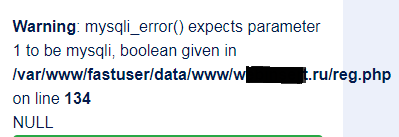 Вводная: есть PHP файл который регистрирует пользователей в базе данных. Вроде бы все хорошо, но пользователь не записывается в базу.
Перед записью открывается соединение, выполняются проверки. То есть соединение с базой данных есть. Сам SQL-запрос составлен правильно, все хорошо. Но данные не записываются в базу, хоть ты тресни.
Возникают два вопроса:
- Почему не работает.
- Как понять, почему не работает.
Второй вопрос более приоритетный, и что?
Для того, что бы посмотреть ошибки, нужно после запроса:
$result = $con->query("INSERT INTO ... запрос ...");
Добавить код, в итоге получиться:
$result = $con->query("INSERT INTO ... запрос ...");

if (!$result) {

var_dump(mysqli_error($result));

}
При этом мы получим ошибку PHP. Это важно понимать, тут ключевая фраза ошибка PHP.
Я получал следующие ошибки:
- Warning: mysqli_error() expects parameter 1 to be mysqli, null given in /var/www/fastuser/data/www/webinsert.ru/reg.php on line 133.
- Warning: mysqli_error() expects parameter 1 to be mysqli, boolean given in /var/www/fastuser/data/www/webinsert.ru/reg.php on line 133
Пользователи на просторах интернета пишут всякий бред, из разряда ты что, не умеешь читать ошибки что ли? Да, от души братуха, о чем говорят ошибки:
MySQL ожидает параметр 1, а получает NULL или логику. То есть ничего не понятно.
Нам нужно понять, в чем ошибка SQL. Я пробовал выполнить запрос на сервере, но он срабатывал.
Что бы понять в чем ошибка SQL нужно перед соединением с БД прописать код:
mysqli_report(MYSQLI_REPORT_ERROR | MYSQLI_REPORT_STRICT);
И, о чудо, после ввода данных в форму регистрации появилась ошибка MySQL:

И теперь стало все понятно.
Данные слишком длинные для столбца ’email’ почты в строке 1.
Смотрю в базу и вижу.

А количество символов в поле e-mail которое я вводил было 22. Вот в чем моя ошибка.

Анатолий Бузов / об авторе
Обучаю HTML, CSS, PHP. Создаю и продвигаю сайты, скрипты и программы. Занимаюсь информационной безопасностью. Рассмотрю различные виды сотрудничества.